Choosing a shower chair is rarely as simple as picking the one that fits the budget or looks right on a showroom floor. The right choice depends on the person's current needs, the trajectory of those needs over time, the layout of their bathroom, and the practical realities of their care routine. Get it right and you have a product that could last years and meaningfully reduce risk. Get it wrong and you may find yourself starting the process again in six months.
This guide walks through the key questions to ask, the factors most people overlook, and the common mistakes worth avoiding.
Start with a professional assessment, not a product
The most important piece of advice before anything else: get an occupational therapist involved before you buy. This is not a sales caution or a liability disclaimer. It is genuinely the most practical thing you can do.
An OT will assess the person's current mobility, balance, and physical capacity. They will look at the bathroom layout. They will also consider where those needs are heading. The chair that suits someone today may be inadequate in 12 months if their condition is progressive, and buying the right product for the likely trajectory rather than just the present moment is far better value.

In Australia, an OT assessment may be funded through the NDIS or My Aged Care depending on the person's age and circumstances, which can also affect whether equipment itself is subsidised. It is worth exploring those pathways before purchasing privately.
Key question to ask yourself first
Do I actually know enough about how my needs, or the needs of the person I am caring for, are likely to change? If the answer is uncertain, an OT assessment before purchasing is genuinely worth the time.
Understanding your bathroom layout
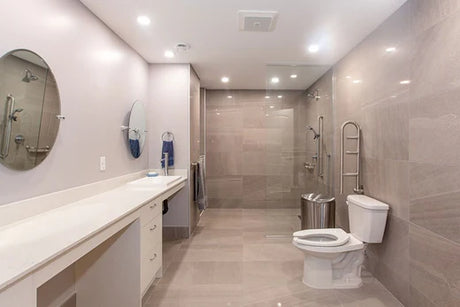
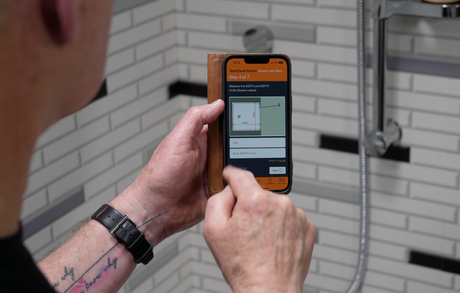
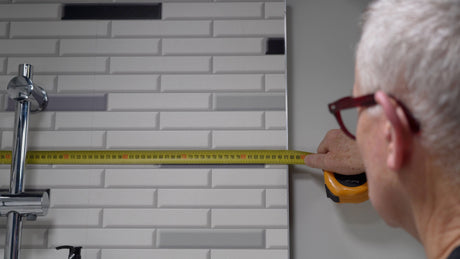
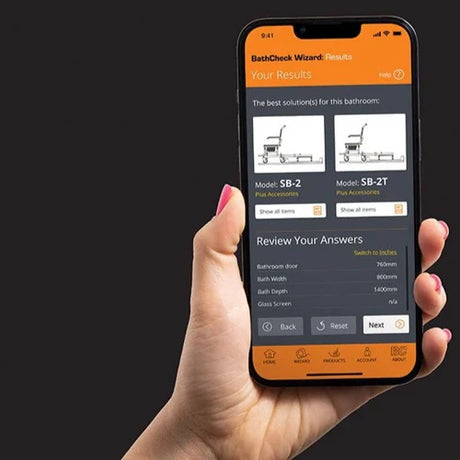
Bathroom layout is one of the most overlooked factors in shower chair selection, and one that can completely change what is possible. Our BathCheck tool can help you work through your specific measurements, but before that, it helps to understand the key barriers to look for.
The central question is: what are the barriers between the person and a safe, comfortable shower? Common barriers include:
- A step or hob at the entrance to a shower cubicle
- A bath rim that needs to be stepped or lifted over
- A narrow doorway that limits which chairs can enter the room
- Limited floor space that restricts turning radius for wheeled chairs
- A wet room or level-access floor that opens up different options
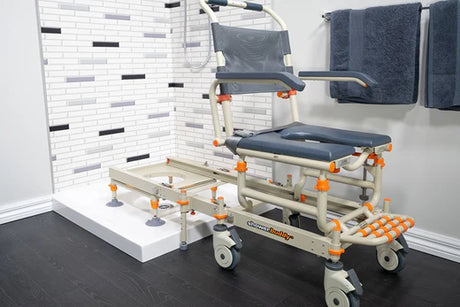
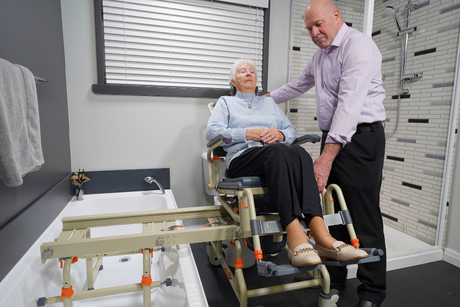
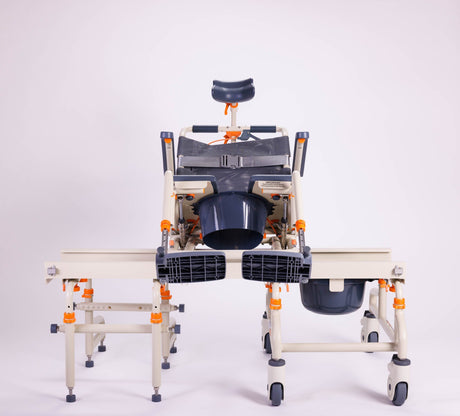
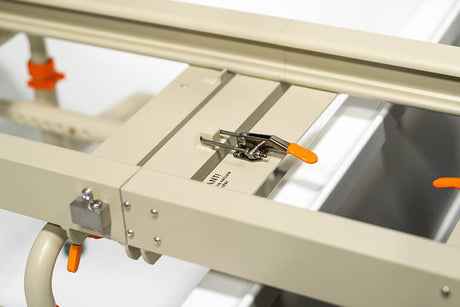
The answers to these questions are not just background context. They determine which product categories are even viable. A sliding transfer chair like the SB1 ShowerBuddy or SB2 TubBuddy, which bridges a shower hob or bath rim to allow a fully-seated transfer, requires specific measurements and configuration to fit the bathroom correctly. A self-propelled shower chair needs enough floor space to manoeuvre.
Going to a mobility store and buying what is on the floor, without having thought through these specifics, is how people end up with a chair that gets them to the entrance of the shower and then leaves them with the same step-over problem they started with.
Thinking about where needs are heading
People's mobility needs tend to change over time, whether through ageing, a progressive condition like MS or ALS, or the ongoing effects of a stroke or injury. A common pattern is that someone buys a basic shower stool from a hardware store because it feels like a modest, non-committal step. That may genuinely suffice for a period. But as mobility decreases further, that stool stops being adequate, and the person ends up going through the purchasing process again, often during a more difficult period.
The more considered approach is to buy for where you are likely to be in two or three years, not just where you are now. That may mean a higher upfront cost, but it also means a product that does not need to be replaced, and a solution that has capacity to adapt.
This is part of why the Showerbuddy range has been developed with accessories and modular components: a chair can be adjusted as needs change, whether that means adding lateral supports, changing the seat configuration, or adapting for a petite frame. You can explore the full range of features and accessories on our website.
Does the person need wheels?
Not every shower chair needs to be a wheeled, mobile unit. The need for wheels is really about what is happening before and after the shower, not just during it.
If someone can walk to the bathroom safely, even with a walking aid, and the primary need is simply to sit while showering, a static seat or stool inside the shower may be sufficient.
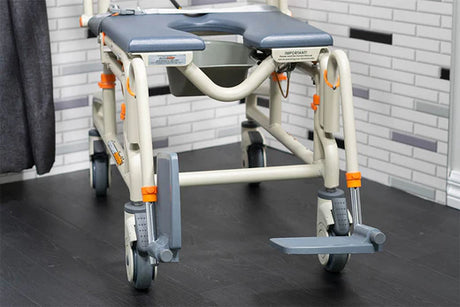
The situation changes when someone is no longer safe walking to the bathroom unaided. Falls in the hallway on the way to the bathroom are not uncommon, and can leave a person on the floor for hours if they live alone or their carer is not immediately available. When that risk is present, a wheeled shower commode chair transforms the bathroom routine: the person is seated from the moment they leave the bedroom, and they do not stand again until they are back in a safe position.

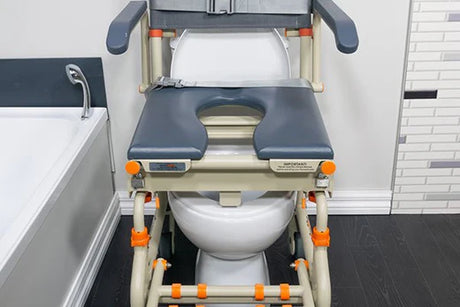
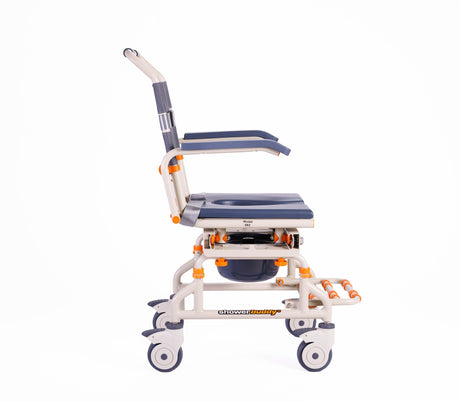
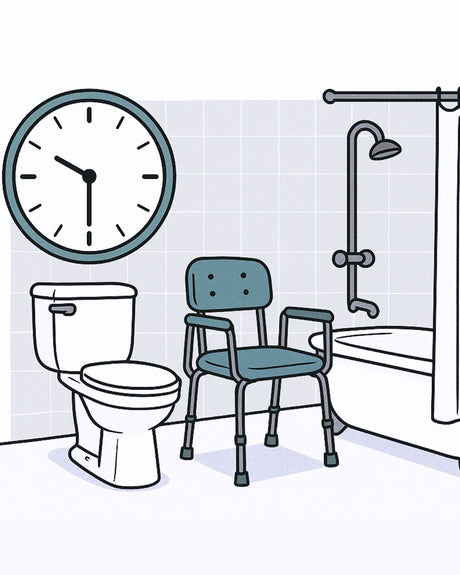
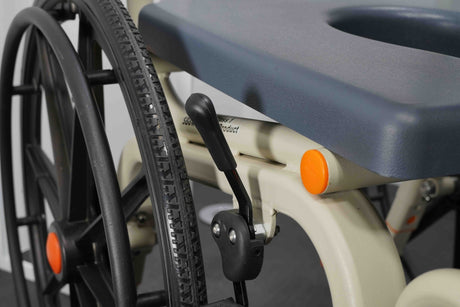
Wheels also open up the commode function, which matters more than people often expect. A wheeled shower commode chair can serve as a toilet chair (rolling over the toilet), a shower chair, and in some configurations, a bedside commode. You can read more about how this works on our shower transfer page.
Does the chair need to fold?
Folding shower chairs, like the SB7e EcoTraveller and SB7W Solo Traveller, are specifically designed for portability and storage. They fold into a bag for travel and can be stored in a cupboard when not in regular use.
These chairs are not typically the right call as a primary home-use solution for someone with complex needs, because the folding mechanism is a design constraint that limits some of the support and stability features found in non-folding models. But they have clear and genuine uses:
- Travel: maintaining independence and a consistent showering routine when away from home
- Smaller homes or apartments where storage space is at a premium
- Visiting family or carers who want equipment available for occasional use without it being in the way
- People with moderate and stable needs who want the convenience of a chair that can be put away
A good folding chair does not have to mean compromise on safety or comfort. The SB7W Solo Traveller, for example, is a self-propelling folding chair with full commode function. The design priorities are simply different from a heavy-duty permanent home unit.
Height adjustability: why it matters more than people expect
Height adjustment is a feature that is easy to overlook when comparing shower chairs, but it is one of the most practically important.
For a static shower chair, seat height affects whether the person can comfortably sit and rise from the chair, and whether their feet rest properly on the floor or footrests. A seat that is too low places significant strain on the knees and hips when getting up, and increases fall risk. A seat that is too high leaves the person's feet dangling, affecting both comfort and stability.
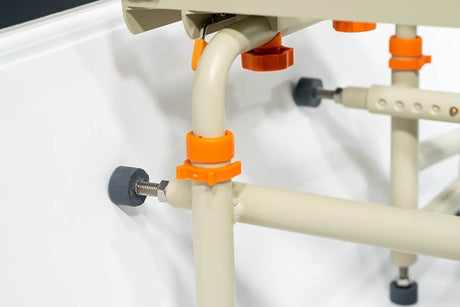
For a transfer chair that slides over a bath or hob, height adjustment is even more critical. The chair needs to be set to the correct height to match the bath rim or shower hob that it will bridge, and then the seat height also needs to suit the person. The BathCheck tool takes you through these measurements step by step and calculates the right configuration for your bathroom.

Getting the seat size right
Chair sizing is often treated as binary (standard or bariatric) but the reality is more nuanced. A person who is physically smaller than average, as is common with elderly users who have lost height and frame over time, may be genuinely unsafe in a standard-sized adult chair. If the seat is too wide, they are not properly supported; in a wet and soapy environment, the risk of sliding or slipping increases.
Showerbuddy offers petite seat adaptors across the range specifically for this reason, in two petite sizes below the standard adult configuration. See the accessories section for details on petite and sizing options.
Quick-reference decision guide
Situation |
Likely right direction |
|
Can walk to bathroom but needs to sit while showering |
Static shower seat or stool |
|
Has a step-in shower, needs to sit, can step over independently |
Static shower seat with armrests |
|
Has a shower over bath, needs to transfer across the bath rim |
Showerbuddy SB2 TubBuddy series |
|
Cannot safely step over a shower hob |
Showerbuddy SB1 ShowerBuddy (sliding transfer) |
|
Can self-propel, needs full bathroom independence |
Self-propelled shower commode: SB6W or SB7W |
|
Needs carer assistance for full bathroom routine |
Wheeled shower commode chair (carer-pushed) |
|
Needs to travel and maintain independence away from home |
Folding travel chair: SB7e EcoTraveller or SB7W |
|
Has complex or progressive condition (MS, ALS, stroke) |
Scripted rehab shower chair: Care Buddy SB9 series |
The most common mistake
After more than 20 years working in this space, the most consistent mistake we see is people waiting too long to seek proper advice, and then buying something quick and low cost to get started. There is understandable psychology at work: accepting that you or a loved one needs a mobility aid is not an easy step, and a cheap plastic stool from the hardware store feels like a less confronting commitment than a proper assessment and a purposeful product.
But the risk in those interim months, particularly for someone whose mobility is already declining and who is showering in a wet environment, is real. And the eventual cost of buying the right product after buying the wrong one is higher than just buying the right product first.
The shower chair that will serve someone well for years is not necessarily expensive or complicated. But it does require knowing what you actually need, which is almost always best determined with professional guidance.
Talk to your occupational therapist about a bathroom assessment, or get in touch with the Showerbuddy team at shower-buddy.com. You can also try our BathCheck tool to get a head start on finding the right configuration for your bathroom.












![Toilet Training A Young Child With Mobility Challenges [And How A Shower Chair Can Help]](http://shower-buddy.com/cdn/shop/articles/toilet-training-disabled-child_520x500_a90e5234-d372-435d-aa56-8da15dd3836c.webp?v=1722557239&width=460)