Walk into any mobility equipment store or search online for bathroom safety products and you will quickly encounter a parade of terms: shower stool, shower seat, shower bench, commode chair, transfer chair, shower wheelchair. For someone trying to find the right solution for themselves or a family member, the language can feel as slippery as a wet bathroom floor.
This guide cuts through the confusion. We have drawn on more than 20 years of experience designing and manufacturing shower mobility equipment to explain what each category actually means, who it is suited to, and when it might be time to move from one to the next.
Why the terminology matters
Bathroom safety is not an area where close enough is good enough. The bathroom is consistently ranked as the most dangerous room in the home for falls and accident-related hospitalisations, and that is a worldwide pattern, not just an Australian one. Getting the right product for the right stage of need can be the difference between maintaining independence and a serious injury.
The terms used for shower chairs are not always used consistently across manufacturers, retailers, and healthcare professionals. An occupational therapist (OT) will often use different language from a hardware store assistant, and what one retailer calls a transfer chair another might describe quite differently. Understanding the underlying distinctions, rather than relying on a label, will help you ask the right questions.
The core categories
Shower stool
A shower stool is the most basic entry-level option: typically a three- or four-legged plastic seat, assembled at home, designed to sit inside a shower cubicle. It has no back support and is designed for someone who has enough balance and mobility to get into the shower independently but wants to sit while showering rather than stand.

Shower stools are low cost, widely available at hardware stores and homeware retailers, and serve a real purpose as an early-stage aid. They help people begin to acknowledge that their needs are changing, and for someone with mild and stable mobility needs, they may be perfectly adequate. Their limitations become apparent when a person's balance and mobility decline further, because they offer no meaningful support during the transition into or out of the shower.
Shower seat
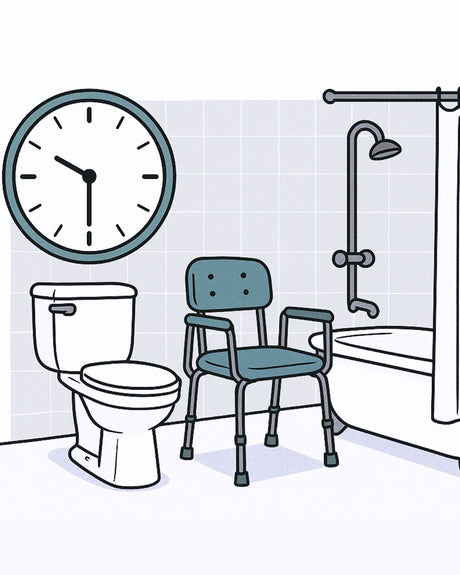
A shower seat is a step up from a stool in that it has a backrest, and sometimes armrests. Beyond that distinction, the term is used broadly to describe a range of seated options for use within a shower. Some are freestanding, some mount to the wall, and some fold down from a bracket when not in use.
Like shower stools, shower seats are suited to someone who can get into the shower under their own steam. They provide a little more support and confidence for someone with early to moderate needs, but they do not address the challenge of stepping over a shower hob or bath rim.
Shower bench
A shower bench is longer than a seat or stool and can span from inside the shower to outside it, which is where the concept of a transfer bench comes in. A basic bench inside a shower cubicle is similar in function to a shower seat. A transfer bench straddles the shower step or bath rim, allowing a person to sit on the outside portion, slide across, and lift their legs in.

Transfer benches still require a degree of mobility: the person or their carer typically needs to assist with lifting the legs over the bath or hob, and the lateral slide takes some effort. They are a reasonable option for someone with low to moderate needs, but they carry a manual handling risk for carers where the person has significant weight or limited leg control. They also allow water to escape the shower enclosure because the tracks that the seat slides on remain in place, allowing water to run outside the shower. This creates a risk of slipping and falls in the bathroom area.
Commode chair
The word commode has French origins and historically referred to a low cabinet that concealed a chamber pot. In the modern mobility context, it refers to a chair with an opening in the seat that can be used over a toilet or with a removable pan underneath.
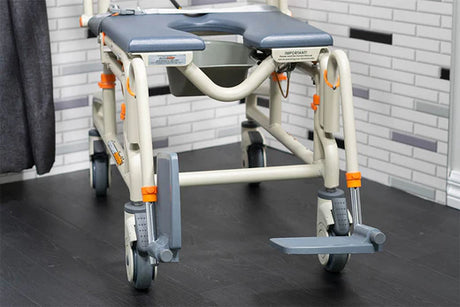
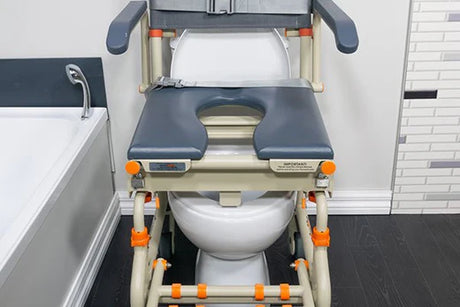
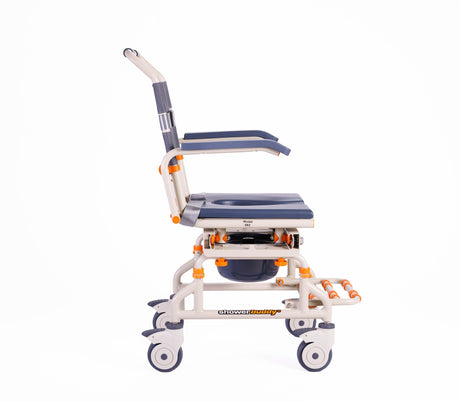
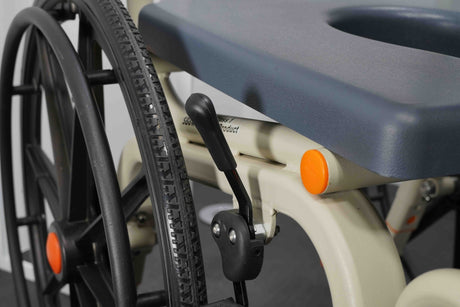
A shower commode chair combines the commode function with the ability to be wheeled into a wet area for showering. This is significant because it means the chair serves multiple purposes: toileting, showering, and in some configurations, transfer from the bedroom. Rather than multiple separate pieces of equipment, one well-specified shower commode chair can handle the whole bathroom routine.
Most quality shower chairs in the mid-to-high range are also commode chairs, and this is worth checking when comparing products. A chair that is purely for showering and requires a separate raised toilet seat or commode adds both cost and complication to the care routine.
Shower wheelchair and self-propelled shower chair
The term "shower wheelchair" is not widely used by OTs or industry professionals, but it is commonly searched by people who are newer to the mobility equipment world and understand the wheelchair concept. In practical terms, it refers to a wheeled shower commode chair that the user can self-propel, typically fitted with larger rear wheels similar to a standard wheelchair. You can read more about how these chairs work on our roll-in shower chair page.
Self-propelled shower chairs are well suited to someone with moderate needs who still has enough upper body strength and dexterity to move themselves around the home, but who is no longer confident or safe walking to the bathroom unaided. The independence they offer, being able to get from the bedroom to the bathroom and through the toileting and showering routine with minimal carer assistance, is important both practically and for the person's sense of dignity.

The Showerbuddy SB6W Roll-inBuddy Solo is a well-established example of this type: a self-propelling shower commode chair suited to home use. For people who want the same independence while travelling, the SB7W Solo Traveller is a lightweight folding version designed to pack into a bag and accompany its user to hotels, holiday accommodation, and beyond.
Transfer chair
The term transfer chair is used fairly loosely in the industry, and this is where real confusion arises. In some mobility stores, a rolling shower chair that simply gets a person to the entrance of the shower is described as a transfer chair, on the basis that it has transferred them from the bedroom. This is a limited interpretation. For a deeper look at what shower transfer actually means, see our shower transfer overview.
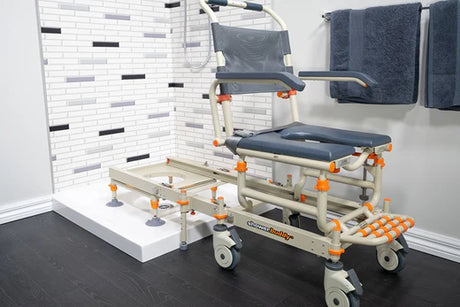
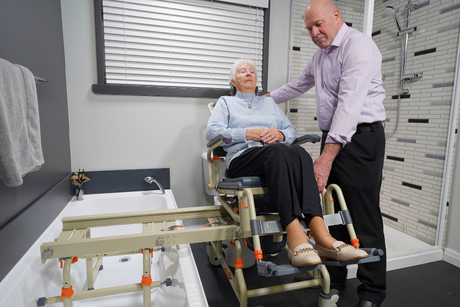
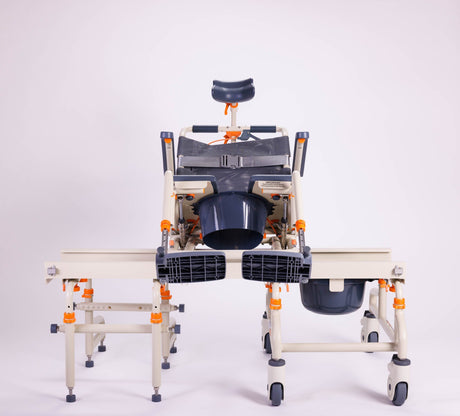
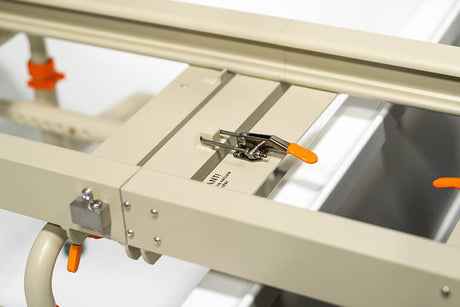
A true transfer chair eliminates the need for the person to stand up, step over a threshold, or be physically lifted at any point in the bathroom journey. Showerbuddy's sliding transfer chairs, including the SB1 ShowerBuddy and SB2 TubBuddy series, achieve this through a bridge-and-slide system: the chair connects to a rail that spans the shower hob or bath rim, and the seated person is slid directly across into the shower base. Nobody stands up. Nobody steps over anything. The carer does not take the person's weight.

This distinction matters enormously from a safety standpoint. The moments of greatest risk in a bathroom routine are transitions: standing up from a chair, stepping over a lip, lowering onto a toilet. A true transfer chair removes those transition moments entirely.
At a glance: how the categories compare
|
Type |
Back support |
Wheels |
Commode function |
Eliminates step-over |
Suited to |
|
Shower stool |
No |
No |
No |
No |
Low needs, independent user |
|
Shower seat |
Yes |
No |
No |
No |
Low to early moderate needs |
|
Transfer bench |
Yes |
No |
No |
Partial |
Moderate needs, some mobility |
|
Shower commode chair |
Yes |
Yes (carer-pushed) |
Yes |
No |
Moderate to high needs |
|
Self-propelled shower chair |
Yes |
Yes (self or carer) |
Yes |
No |
Moderate needs, some independence |
|
Sliding transfer chair |
Yes |
Yes |
Yes |
Yes (fully seated) |
High needs, minimal mobility |
Standard and bariatric options
Most shower chairs are designed to a standard weight capacity, typically up to around 160 kg, which covers the majority of users. Bariatric versions are built wider and to a higher weight rating, commonly 200 to 300 kg depending on the model and manufacturer.
Some chairs in the standard range can be adapted with accessories to widen the seat between the armrests for someone with a broader frame, even where the weight limit does not change. If you or the person you are caring for sits toward the edge of the standard sizing, it is worth raising this with the supplier or your OT rather than automatically defaulting to a bariatric model.

Fixed, fold-down, and mobile: what is the difference?
Beyond the categories above, shower chairs also differ in how they are positioned in the bathroom when not in use.
A fixed or fold-down seat is mounted to the wall, either permanently or on a bracket that folds flat. These are common in accessible hotel bathrooms and some purpose-built wet rooms. They suit someone with enough mobility to step into the shower and lower themselves onto a fixed seat. They do not help with the transfer problem.
A mobile shower commode, by contrast, is wheeled into the bathroom as needed. It is the appropriate solution when someone has reduced mobility to the point that they are at genuine risk in the bathroom, and when their overall care routine benefits from having one chair serve multiple functions throughout the day.
Not sure which category fits your situation?
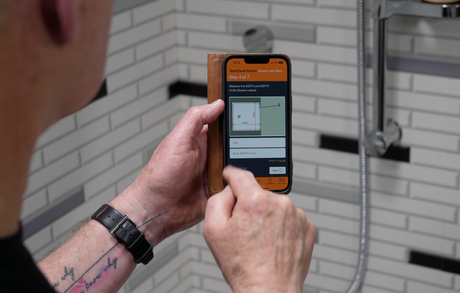
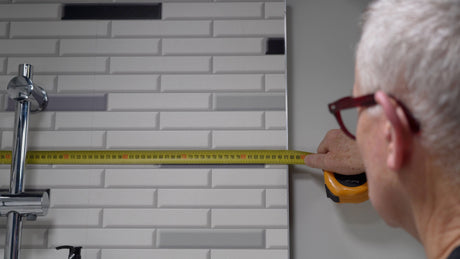
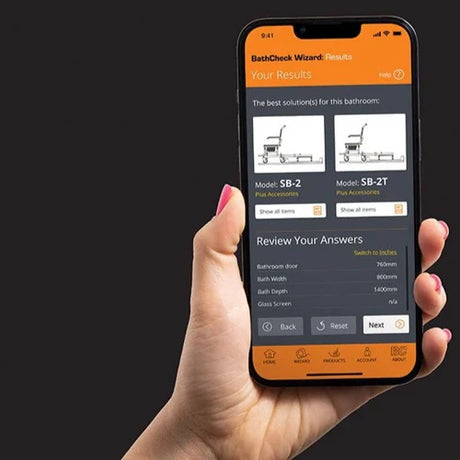
Choosing the right shower chair involves more than matching a label. Our BathCheck tool can guide you through your bathroom measurements and recommend the most suitable Showerbuddy products. For a broader overview of what to look for when buying, see our features guide, or browse the full product range.
An occupational therapist can also assess the specific needs of the person, the layout of the bathroom, and the likely progression of those needs over time. That assessment often changes the choice significantly, and in Australia may be funded through the NDIS, Support at Home or My Aged Care.
Talk to your occupational therapist about a formal bathroom assessment, or get in touch with the Showerbuddy team to discuss your situation and find a solution that actually works.












![Toilet Training A Young Child With Mobility Challenges [And How A Shower Chair Can Help]](http://shower-buddy.com/cdn/shop/articles/toilet-training-disabled-child_520x500_a90e5234-d372-435d-aa56-8da15dd3836c.webp?v=1722557239&width=460)