Most shower chairs are designed to a standard specification. They come off a production line with a defined set of features, and the person using them adapts to the chair. That approach works well across a wide range of needs. But for people with complex, progressive, or highly individual conditions, it falls short.
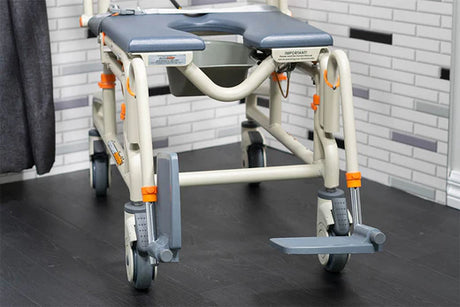
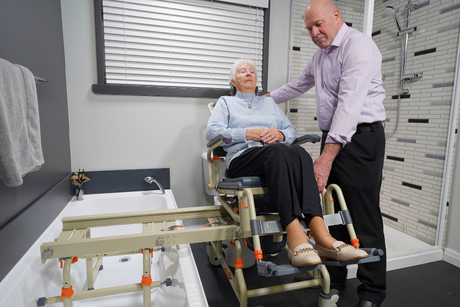
The Care Buddy SB9 series is Showerbuddy's answer to that gap. Rather than a fixed product, it is a configurable system: a single chair platform that can be specified, scripted, and assembled to match the precise requirements of each individual user, and then adapted further as those requirements change over time. You can explore the full product range to see where the SB9 sits alongside the rest of the Showerbuddy lineup.
Who is the Care Buddy designed for?
The SB9 series is designed for people with complex mobility and positioning needs, typically those with progressive neurological conditions, significant physical disability, or situations where standard shower chairs simply do not provide adequate support or safety.
Conditions where the Care Buddy is particularly well suited include:
- Multiple sclerosis (MS), where muscle weakness and spasticity affect posture and positioning
- Amyotrophic lateral sclerosis (ALS), where progressive loss of muscle control requires increasing levels of support over time
- Stroke survivors with hemiplegia or significant weakness on one side
- Acquired brain injury and spinal cord injury where trunk support, limb positioning, and head and neck control are factors
- Limb differences, including amputation, where standard footrests and leg supports do not apply symmetrically
An occupational therapist or rehabilitation specialist is the appropriate professional to determine whether the SB9 series is right for a given person. The scripting process, selecting the exact configuration of supports, wheels, and accessories, is a clinical task rather than a retail one.

One platform, three configurations
The defining feature of the Care Buddy SB9 is that it is not a single fixed chair. The platform can be configured in three meaningfully different ways, depending on the user's mobility level and care context.
Configuration 1: Full carer-assisted
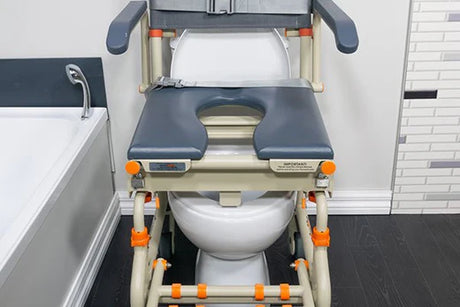
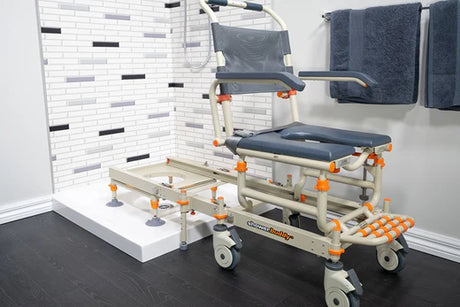
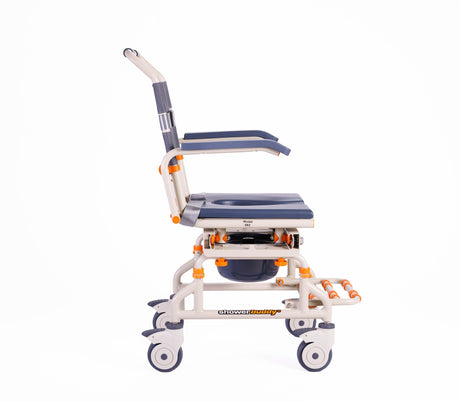
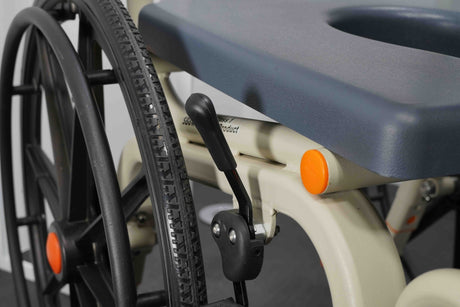
In this setup, the SB9 has four caster wheels, all of medium diameter. The chair is fully managed by a carer: pushed, positioned, and supported throughout the bathroom routine. This is suited to users who have very limited or no independent mobility and require full assistance for showering, toileting, and transfer and have an accessible bathroom
Configuration 2: Self-propelled with large rear wheels
For users with enough upper body strength to self-propel, the SB9 can be fitted with large 22-inch rear wheels, similar to a standard manual wheelchair. This gives the user the ability to move themselves around the home and bathroom independently while retaining all the postural support features of the CareBuddy system.
Self-propulsion matters beyond the practical convenience. Being able to move through one's own home without assistance, even partially, has a significant effect on dignity and psychological wellbeing. The SB9 in this configuration offers that independence without requiring a separate wheelchair for daily movement and a separate shower chair for bathing.
Configuration 3: Large wheels at the front
A less common but increasingly valued configuration places the larger wheels at the front of the chair rather than the rear. This is particularly useful in homes with carpet, rugs, or door thresholds. Smaller caster wheels at the front tend to catch on these surfaces; the larger front wheels roll over them more easily, making the chair significantly easier to manoeuvre through a typical home environment.
Recent feedback from OT seminars has indicated growing interest in this configuration, particularly for home use in older housing stock where flooring transitions between rooms are common.
What does "scripted" mean?The term scripted is borrowed from the complex rehab technology sector, where it refers to the process of an OT or rehabilitation specialist prescribing a chair configuration tailored to an individual. For the SB9, scripting means specifying the exact combination of wheel configuration, supports, seating, and accessories before the chair is assembled. There is no off-the-shelf SB9; each one is built to a prescription. |
The supports system: built for individual positioning
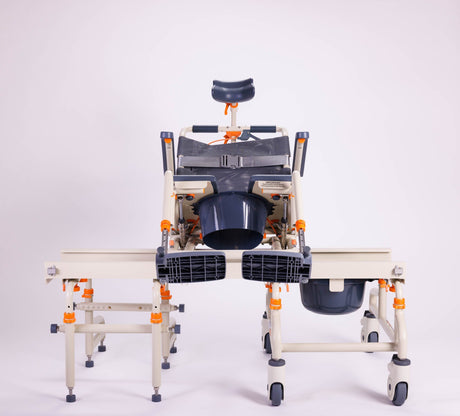
What makes the CareBuddy genuinely different from a standard shower commode chair is the depth and specificity of the support options available. These are clinical positioning components designed to keep a person with complex needs safe, comfortable, and correctly positioned throughout the showering routine.
Support component |
What it addresses |
|
Lateral trunk supports |
Prevents lateral lean for users with poor core muscle control |
|
Thigh supports |
Positions and stabilises the thighs for users with spasticity or asymmetric muscle tone |
|
Calf support |
Holds the lower leg in position, relevant for users with limited lower limb control |
|
Stump support |
Provides a platform for a residual limb on the relevant side, for users with amputation |
|
Standard neck rest |
Basic head and neck support for users with moderate head control |
|
Multi-function neck rest |
Adjustable to any position, for users with progressive head and neck drop |
|
Padded tension backrest |
Accommodates users who have developed posterior pelvic tilt or spinal changes over time |
|
Moulded backrest |
Contoured support for users who need more precise trunk positioning |
|
Forward tilt function |
Tilts the seat forward to assist the user in transferring on and off the chair more easily |
Adapting as needs change
One of the more significant practical advantages of the SB9 system is that the chair can be modified over time without needing to be replaced. This is particularly relevant for people with progressive conditions, where the level of support required will increase.
To take a concrete example: someone with ALS may start with the self-propelled configuration and a standard backrest. As the condition progresses, they might transition to the carer-assisted configuration, add lateral supports, move to a padded tension backrest as their posture changes, and add a multi-function neck rest as head control decreases. Each of these changes can be made to the same chair. The person does not need to be moved to a new product at each stage of decline.
Similarly, for a user who is in rehabilitation and whose function may be improving, the chair can be scaled back as independence increases.
A practical example: fitting the SB9 for an amputee
One of the clearer illustrations of why scripting matters is the case of a unilateral leg amputee. A standard shower chair has two footrests of the same configuration. For someone with an amputation on the left side, that means one side has a footrest supporting a limb that is not there.
On the SB9, the appropriate configuration for that user would be a stump support on the amputated side, sized and positioned for the residual limb, and a standard footrest on the intact side. These are not the same component, and a standard off-the-shelf chair cannot accommodate both. The scripted approach means the chair is actually built for that person's body.
The role of the OT in CareBuddy prescription
Because the SB9 series is a complex rehab product, the involvement of an occupational therapist or rehabilitation specialist is not just recommended, it is essentially required to get the prescription right. The OT will assess the user's postural needs, determine which supports are necessary, specify the wheel configuration, and work with the Showerbuddy team to ensure the scripted configuration is correct before the chair is built.
In many cases, funding for a complex rehab shower chair of this type may be available through the NDIS for eligible participants.
How the CareBuddy fits within the Showerbuddy range
The Showerbuddy range covers the full spectrum of shower mobility needs, from the lightweight and portable SB7e EcoTraveller through to the mid-range sliding transfer chairs of the SB1 and SB2 series, and now the CareBuddy SB9 at the complex rehab end. The SB9 is not a replacement for the rest of the range. It is the right choice for a specific and significant group of users whose needs go beyond what a standard chair can address.
Understanding where on that spectrum a person sits, and being honest about where they are likely to sit in two years, is the basis for a good decision.
In summary
The CareBuddy SB9 is a fully scripted, configurable complex rehab shower commode chair designed for people with significant and often progressive mobility and positioning needs. It can be configured in three different wheel arrangements, fitted with a comprehensive range of clinical supports, and adapted over time as needs change. It is prescribed in collaboration with an occupational therapist and is available through Showerbuddy for home, facility, and rehabilitation use.
Talk to your occupational therapist or rehabilitation specialist about whether the SB9 series suits your needs. You can also contact the Showerbuddy team directly at shower-buddy.com to discuss the scripting process, request a product consultation, or learn more about the full range.






![Toilet Training A Young Child With Mobility Challenges [And How A Shower Chair Can Help]](http://shower-buddy.com/cdn/shop/articles/toilet-training-disabled-child_520x500_a90e5234-d372-435d-aa56-8da15dd3836c.webp?v=1722557239&width=460)